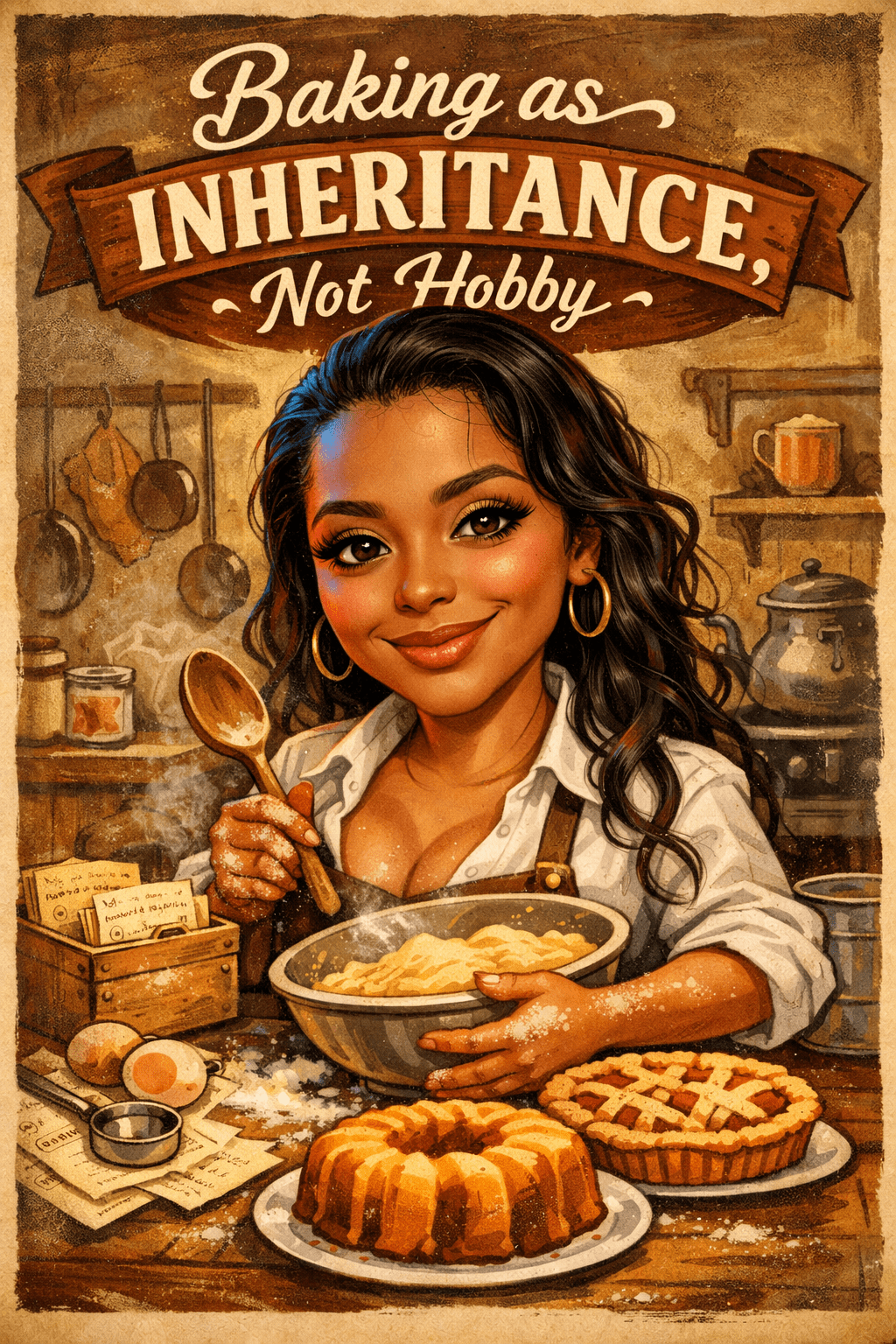
For many of us, baking was never just something you picked up one day.
It wasn’t a cute pastime. It wasn’t a trend. It was passed down—quietly, lovingly, and with intention.
In Black families, baking has always been inheritance.
It lived in kitchens without measuring cups.
In recipes written on the backs of envelopes—or never written at all.
In hands that knew when the dough was ready, when the oven was hot enough, when the cake was done just by the smell.
The Kitchen Was a Classroom
Long before baking shows and social media, our elders taught through observation.
You learned by watching:
- how sugar and butter were creamed until “it looked right”
- how to stretch ingredients when money was tight
- how to make something beautiful out of very little
No one called it “training,” but that’s exactly what it was.
The kitchen was where patience was learned.
Where timing mattered.
Where love was folded in with intention.
Baking as Survival, Care, and Celebration
Baking in Black history has always worn many hats.
It was survival—making meals stretch, feeding many mouths with few resources.
It was care—cakes for funerals, pies for sick neighbors, bread for families who needed it.
It was celebration—birthdays, Sundays, holidays, church gatherings, and milestones.
Dessert wasn’t extra.
It was a language.
A way to say I love you, I see you, I’m proud of you, you matter.
What Was Passed Down Was More Than Recipes
When we inherited baking, we inherited:
- intuition
- resilience
- creativity
- discipline
- pride
We learned how to show up for people.
How to create joy even when circumstances were heavy.
How to leave a mark without asking permission.
Those lessons didn’t come from cookbooks.
They came from watching our grandmothers, aunties, mothers, and elders move through the kitchen with quiet authority.
Reclaiming the Narrative
Today, baking is often framed as a “hobby.”
Something soft. Something casual. Something optional.
But for many of us, it’s ancestral work.
It’s legacy.
It’s memory.
It’s skill refined through generations.
When a Black woman bakes, she isn’t just creating dessert—she’s continuing a story.
A story of hands that worked hard.
Of kitchens that held families together.
Of creativity that flourished even when recognition didn’t.
Carrying It Forward
To bake today—whether for family, community, or business—is to honor what came before.
It’s choosing to:
- keep traditions alive
- respect the labor behind the love
- treat baking as the craft and inheritance it has always been
This Black History Month, we honor the kitchens that raised us, the hands that taught us, and the legacy we continue every time we turn on the oven.
Because baking was never just a hobby.
It was — and still is — inheritance.
 Dot's Petite Bakery CO.